5-minute read
I thought making a candle would be easy.
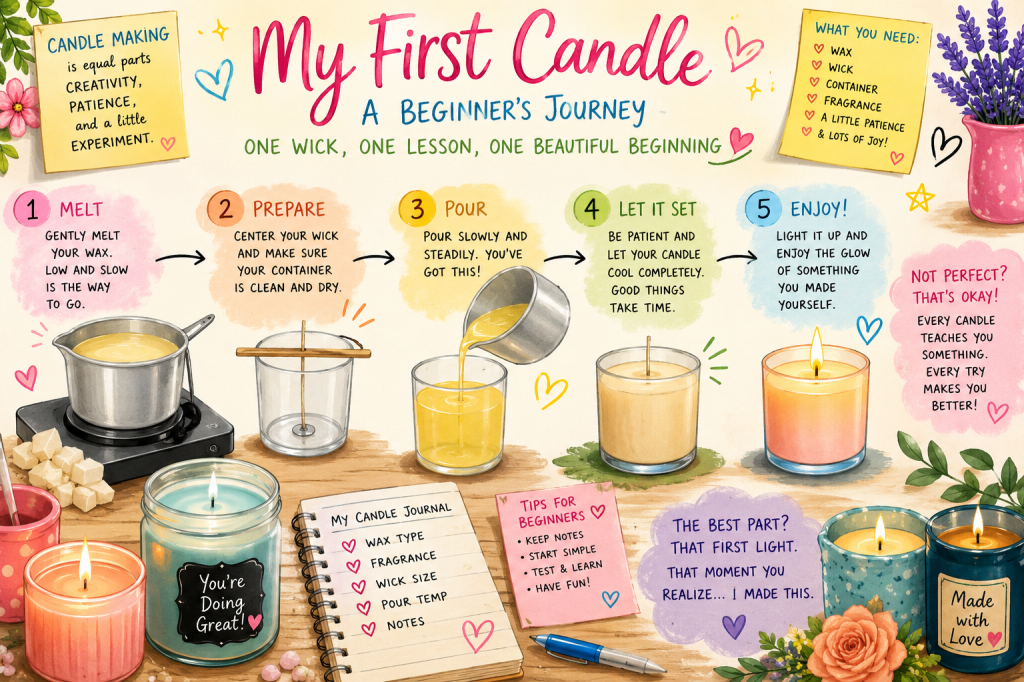
Melt some wax. Add a little fragrance. Put a wick in the middle. Let it cool.
Done.
At least, that’s what I told myself before I tried it.
Then came the wax.
The wick moved.
The fragrance didn’t seem to behave the way I expected.
And somehow, the beautiful, smooth candle I had pictured in my head turned into something that looked like it had been through a very small weather event.
I stared at it for a minute.
Then I laughed.
Because there it was: my first candle.
Not perfect.
Not Instagram-worthy.
But mine.
And that’s when I realized that learning to make candles isn’t really about making the perfect candle on your first try. It’s about learning how all those little pieces—wax, wick, fragrance, temperature, timing—work together.
And just like anything worth learning, you have to start somewhere.
Everyone Starts With Melted Wax
There is something strangely exciting about watching a solid block of wax slowly turn into a liquid.
At first, you’re just standing there watching it melt.
Then you start thinking, Okay, this is actually happening.
But candle making has a way of reminding you that simple doesn’t necessarily mean effortless.
The wax has to be heated properly.
The wick needs to be centered.
The container needs to be suitable for candles.
The fragrance needs to be measured rather than simply poured in because it “looks about right.”
And then there’s the waiting.
Oh, the waiting.
You finally pour your candle and want to touch it immediately.
Don’t.
Let it set.
Let it cool.
Give it time.
Apparently, candle making has lessons in patience built right into the process.
My First Candle Was Definitely a Learning Experience
I quickly discovered that candles have personalities.
Okay, maybe that’s not technically true.
But it certainly feels that way when one candle comes out beautifully and the next one decides to develop a little crater in the middle.
Or a frosting effect.
Or a surface that looks nothing like the smooth finish you were hoping for.
The first time something went wrong, I thought I had completely messed it up.
Then I learned something important:
A candle that doesn’t look perfect isn’t necessarily a failed candle.
Sometimes it simply means you learned something.
Maybe the temperature wasn’t quite right.
Maybe the candle cooled too quickly.
Maybe the wax behaves differently than another wax you’ve used.
Maybe the wick isn’t the best match for the container.
That’s not failure.
That’s information.
And when you’re learning, information is useful.
Don’t Buy Everything at Once
If you’re thinking about trying candle making, it’s tempting to go a little crazy.
You see beautiful jars.
Then fragrance oils.
Then dried flowers.
Then colorful wax.
Then ten different kinds of wicks.
Suddenly your “simple little hobby” requires an entire cabinet.
Take it from a beginner: start small.
Choose one wax.
Choose a suitable container.
Use a wick designed for that type and size of candle.
Pick one fragrance you really love.
Learn how those basic ingredients behave before adding a dozen more variables.
The more things you change at once, the harder it becomes to figure out what went wrong.
Keep your first experiments simple.
Your future self will thank you.
Measure. Don’t Guess.
This was one of those lessons I had to learn quickly.
When you’re making something at home, there’s a temptation to think, A little more won’t hurt.
With candle making, that’s not always a great approach.
Wax, fragrance, and wick selection all need some thought.
More fragrance doesn’t automatically mean a better-smelling candle.
A bigger wick doesn’t automatically mean a better flame.
And adding something decorative doesn’t automatically make a candle better.
Candle making is part craft and part little experiment.
Keep notes.
Write down the wax you used.
Record the fragrance.
Note the amount.
Write down the wick size.
Pay attention to how the candle burns.
That little notebook may become one of your most useful candle-making tools.
The Wick Is More Important Than You Think
I’ll admit it.
When I first started, the wick seemed like the least interesting part.
I was much more interested in the wax and fragrance.
The wick was just…the wick.
Not quite.
The wick is responsible for delivering the melted wax to the flame, and choosing the right wick for your wax and container is an important part of making a candle that burns properly.
This is one of those things you learn very quickly once you start testing your candles.
A candle can look beautiful and still need some adjusting.
That’s why experienced candle makers test.
They don’t just make one candle and assume they’ve figured everything out.
They watch.
They observe.
They make changes.
And then they try again.
Candle Making Is a Little Like Cooking
Think about the first time you cooked something without a recipe.
Maybe it turned out wonderfully.
Maybe it didn’t.
Either way, you learned something.
Candle making feels similar.
There are basic principles you need to understand, but there is also a lot of observation.
You start noticing how your wax behaves.
You learn how different fragrances perform.
You begin recognizing what a healthy melt pool looks like.
You start paying attention to the flame.
Eventually, you stop following every step nervously and start understanding why you’re doing each step.
That’s when it gets really fun.
Your First Candle Might Have Imperfections
Mine did.
And honestly, I’m glad.
Because a perfectly smooth first candle might have looked nice, but it wouldn’t have taught me nearly as much.
Those little imperfections made me curious.
Why did that happen?
What could I change?
What happens if I try again?
That’s how a hobby becomes a skill.
You don’t learn everything before you begin.
You learn by beginning.
There Is Something Special About Making Something You Can Light
Maybe that’s why candle making hooked me.
At the end of all the measuring, melting, waiting, testing, and occasionally wondering what on earth happened to your candle—you get to light it.
And that little flame changes everything.
The room feels warmer.
The fragrance begins to fill the air.
And you get to sit there knowing that something you made with your own hands is now creating a little atmosphere around you.
That’s a pretty satisfying feeling.
If You’re Thinking About Making Candles
Start simple.
Learn about your wax.
Choose the right container.
Use an appropriate wick.
Measure your materials carefully.
Keep notes.
Test your candles.
And don’t expect your first attempt to look like something from a luxury candle shop.
Let your first candle be your first candle.
Let it teach you.
Maybe the surface isn’t perfect.
Maybe the scent isn’t quite what you imagined.
Maybe the wick needs changing.
That’s okay.
Make another one.
And then another.
Eventually, you’ll find yourself doing things that once seemed complicated without even thinking about them.
You’ll know which wax you like.
You’ll understand how your favorite fragrance behaves.
You’ll recognize when something doesn’t look quite right.
And one day you’ll light a candle you’ve made and realize:
I actually made this.
That’s the part I love most.
Not perfection.
Not having a shelf full of beautiful candles.
Just the simple satisfaction of learning something new and making something with your own two hands.
And really, isn’t that how most good hobbies begin?
With a little curiosity, a little patience, and one slightly imperfect first attempt.
 TELL AND TALE
Leave a comment